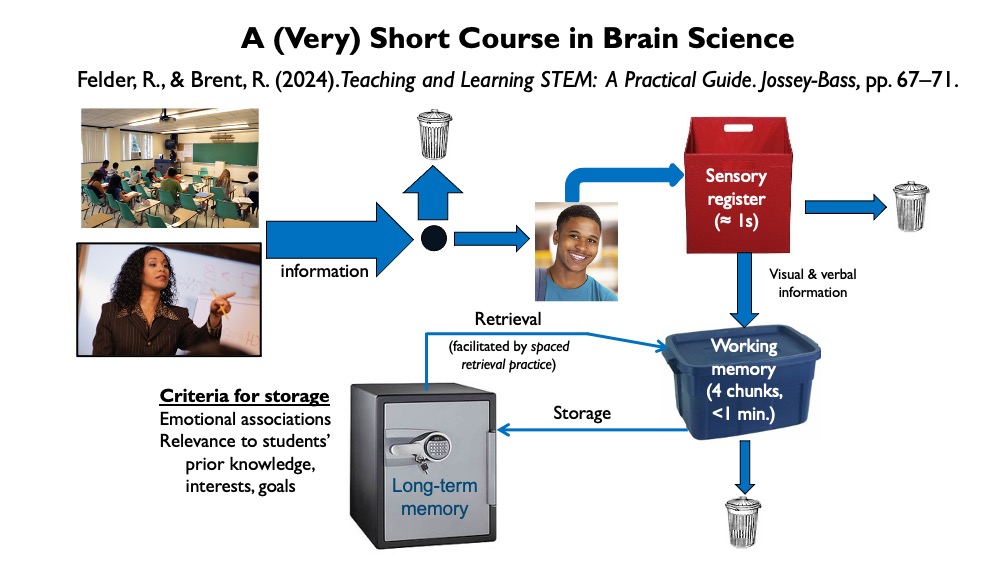
Following are the main features of the learning model you see above:
- Learning is a process in which information enters your brain through your senses (sight, hearing, taste, touch, smell), undergoes a series of screening processes, and if certain conditions are met, goes into your working memory, where you do all of your conscious information processing. In working memory, each entering chunk of information is subjected to additional screening that takes place in about a minute or less. If one or more other conditions are adequately met (notably that the information has emotional associations for you or is related to information you already know or to your personal interests and goals), it is stored in your long-term memory; otherwise, it is discarded and permanently lost to you. If information makes it to your long-term memory, you can say you have learned it.
- Once information is in your long-term memory, it remains there for a very long time, possibly for the rest of your life. It can then be searched for and retrieved if a need for it arises (such as on a course examination), brought back to working memory, and used. The more a piece of information is retrieved, with the intervals between retrievals progressively increasing (“spaced retrieval practice,”) the easier its subsequent retrieval becomes.
The model has several important implications for teachers:
- When you present students with new information, the more you can relate it to their prior knowledge, interests, and goals, the more likely they will be to learn it.
- If you teach information once, even if it is stored in long-term memory it may be difficult for the students to retrieve it later. The more practice students get in retrieving information, the easier it will be for them to retrieve it again (such as on your exam). The retrievals should take place at increasingly widely-spaced intervals (spaced retrieval practice).
- Working memory has a highly limited information processing capacity. It can only hold 3–5 chunks of information at a time and has less than a minute to decide whether to store or discard each chunk. If you fire-hose students with information in a traditional non-stop lecture, most of the information will be irretrievably lost to them. You can greatly improve learning by using active learning, interspersing short lecture segments with short activities in which the students retrieve and apply the information presented in the lectures.
- Most students study for examinations by rereading their textbooks and old homework problem solutions, which gives them illusions of competence. The problem is that they are just casting their eyes over information but not retrieving it from their long-term memories, and so they are less likely to do well on examinations that require it. To help your students, teach them to help themselves prepare for tests by testing themselves or each other on memorized information and problem solutions, without looking at the answers and solutions. If they get stuck on a problem, they can look up the solution, put the problem aside for several hours or days, and then try again to solve it without looking. If their test grades have been low, this studying procedure is likely to lead to dramatic improvements, and giving them this advice can have a greater impact on their academic performance than anything else you say or do in class.
Reference for this post and to learn more, go to
Felder, R., & Brent, R. (2024). Meet your brain (pp. 67-71). In Teaching and learning STEM: A practical guide (2nd ed.). Jossey-Bass, “
Please follow and like us:


